
This section provides download links from Google Drive for NCERT Economics Books of Class 11th to 12th in Hindi Medium. Please click the Hyperlink (red colour) and thereafter in Google Drive click the Download button given at the upper right side, or click the three-dot menu (on Mobile) and then click the Download button.
NCERT Economics Books Hindi Medium Download Links
- Class 11 NCERT Economics Book (Part I): सांख्यिकी (Statistics for Economics)
- Class 11 NCERT Economics Book (Part II): भारतीय आर्थिक विकास (Indian Economic Development)
- Class 12 NCERT Economics Book (Part I): समष्टि अर्थशास्त्र (Macroeconomics)
- Class 12 NCERT Economics Book (Part II): व्यष्टि अर्थशास्त्र (Microeconomics)
You may visit our Economics Section for more updates here. For Objective MCQs on Economics, please visit here. Kindly also visit our other sections here.
Introduction to Economics
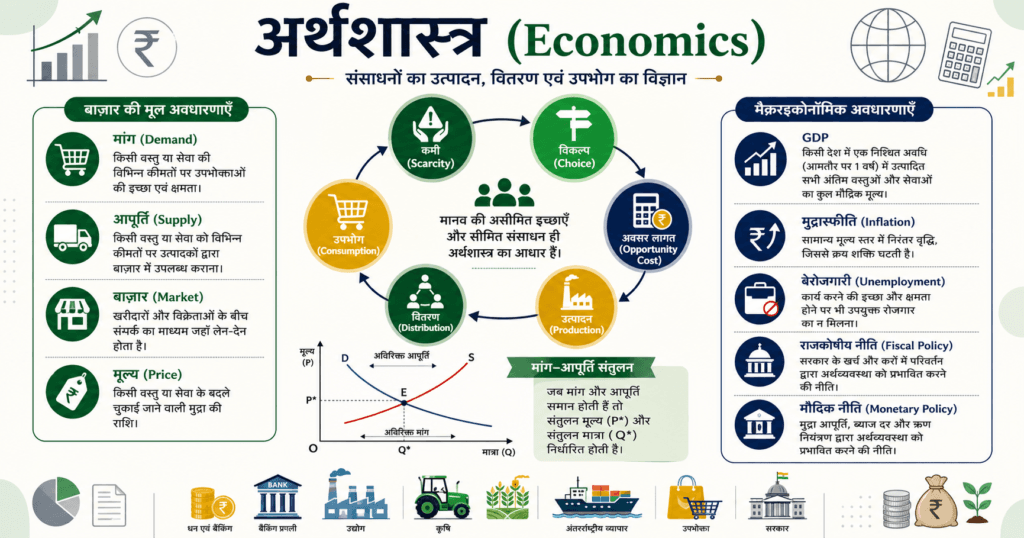
Economics is the social science that studies how individuals, businesses, and governments use limited resources to satisfy unlimited human wants. It examines the production, distribution, exchange, and consumption of goods and services, helping societies make informed decisions about resource allocation and economic development.
As a subject, economics is essential for understanding national growth, employment, inflation, poverty, trade, public finance, and sustainable development. It also plays a significant role in policymaking and improving the standard of living.
What is Economics?
The word Economics is derived from the Greek word “Oikonomia,” meaning household management. Modern economics extends this idea to the management of resources at the individual, business, national, and global levels.
Economics seeks to answer questions such as:
- What goods and services should be produced?
- How should resources be allocated efficiently?
- Why do inflation and unemployment occur?
- How do governments influence economic growth?
- What factors determine income, prices, and living standards?
Branches of Economics
Economics is a vast discipline consisting of several important branches.
1. Microeconomics
Studies the economic behavior of individuals, households, and firms. It focuses on demand, supply, price determination, consumer behavior, and market structures.
2. Macroeconomics
Deals with the economy as a whole. It studies national income, inflation, unemployment, economic growth, fiscal policy, and monetary policy.
3. Development Economics
Examines the economic progress of developing countries by focusing on poverty reduction, employment generation, infrastructure, education, and inclusive growth.
4. International Economics
Studies international trade, foreign exchange, balance of payments, globalization, and international financial institutions.
5. Public Economics
Focuses on government expenditure, taxation, public debt, budgeting, and the role of the government in economic development.
6. Agricultural Economics
Analyzes agricultural production, rural development, food security, agricultural markets, and government support policies.
7. Environmental Economics
Studies the relationship between economic activities and the environment, including pollution control, climate change, and sustainable resource management.
8. Behavioral Economics
Combines economics with psychology to understand how people make economic decisions under uncertainty and real-world conditions.
Importance of Economics
Economics affects almost every aspect of daily life.
- Efficient Resource Allocation: Helps individuals, businesses, and governments make better economic decisions.
- Economic Development: Guides policies that promote growth, employment, and industrial development.
- Poverty Reduction: Assists governments in designing welfare schemes and inclusive development policies.
- Financial Awareness: Improves understanding of banking, savings, investment, taxation, and budgeting.
- Business Decision-Making: Helps firms determine production, pricing, investment, and expansion strategies.
- Global Understanding: Explains international trade, globalization, exchange rates, and economic cooperation.
Economics and Economic Development
Economics plays a crucial role in improving the quality of life by promoting sustainable growth and balanced development.
- Growth and Employment: Supports policies that increase production and create employment opportunities.
- Price Stability: Helps control inflation and maintain purchasing power.
- Income Distribution: Studies methods to reduce inequality and improve social welfare.
- Fiscal and Monetary Policies: Assists governments and central banks in maintaining economic stability.
- Sustainable Development: Encourages responsible use of natural resources while ensuring long-term prosperity.
Importance of Economics in Government Job Competitive Exams
Economics is one of the most important subjects for aspirants preparing for UPSC, SSC, State PSCs, Banking, Railways, Defence, Teaching, and other competitive examinations.
- Major Syllabus Component: Economics forms a significant part of General Studies in UPSC, State PCS, SSC, Banking, RBI, NABARD, and other examinations.
- Foundation for Current Affairs: Understanding the Union Budget, Economic Survey, inflation, GDP, unemployment, banking reforms, and government schemes requires economic knowledge.
- Answer Writing: Economics helps candidates write analytical answers on development, governance, public policy, taxation, and social welfare.
- Interview Preparation: Knowledge of economic issues enhances awareness of national and international developments and improves decision-making ability.
- High Scoring Subject: Most economics questions are conceptual and practical, making them easier to understand and score with regular practice.
Conclusion
Economics is much more than the study of money—it is the science of making choices in a world of limited resources. It explains how economies function, how governments formulate policies, and how individuals and businesses make financial decisions. From understanding inflation and employment to analyzing economic growth and sustainable development, economics provides essential knowledge for informed citizenship.
For competitive examination aspirants, economics is a highly valuable subject that strengthens analytical thinking, enhances awareness of current affairs, and improves performance in both written examinations and interviews. A strong foundation in economics not only helps in securing good scores but also develops a better understanding of the economy and society.